What could be more enjoyable for a rider than training on a perfectly smooth arena, free of holes and bumps, with just the right level of moisture? Conversely, who hasn’t complained about a poorly maintained surface? Not only does the horse struggle to find its balance, but the risk of injury or a fall is very real.
We also know that a good arena represents a significant investment. To extend its lifespan and ensure optimal working conditions, there’s no secret: it must be carefully maintained. Some studies even suggest that the quality of an arena is defined entirely by its maintenance.
In this article, we’ll look at why arena maintenance is crucial for the safety of both horse and rider, as well as for the longevity of the surface itself. Finally, we’ll share practical tips to help you keep your arena performing at its best.
The challenges of a poorly maintained arena
A poorly maintained arena can have many negative consequences — not only for the horses’ health but also for the riders’ safety and the longevity of the surface itself.

Over time, an arena can become too hard, too soft, or uneven, developing holes or bumps. Each flaw in the surface has a direct impact on the horse. A surface that’s too hard causes repeated shocks to the hooves, tendons, and joints, increasing the risk of injuries such as arthritis. Conversely, a surface that’s too soft can quickly tire the horse: with every stride, it sinks deeper and must exert more effort, putting significant strain on the tendons and potentially leading to tendonitis.
Irregularities in the surface present another danger. Holes and bumps disrupt the horse’s balance, which can cause it to stumble, fall, or sustain injuries of varying severity. The rider, in turn, is also exposed to the risk of falling and getting hurt.
Beyond safety, the quality of the work also suffers. A horse moving on an unstable surface cannot find its balance or maintain consistency in its movements. As a result, the horse–rider pair loses stability, rhythm, and overall performance.
Finally, a neglected arena deteriorates quickly. Holes and bumps worsen over time, eventually making the surface beyond repair. In the best-case scenario, you’ll need to call in a professional with laser equipment to level it again. In the worst case, the only option is to completely rebuild the arena — a costly investment.
How to maintain your arena?
Arena maintenance depends heavily on its composition. Non-fibered arenas, made solely of sand, are more sensitive to external conditions. Without fibers to stabilize the surface, they tend to compact quickly, produce dust during dry periods, or develop ruts after repeated use. To maintain a consistent surface, they require daily dragging, regular watering to limit dust and ensure good cohesion, as well as careful monitoring to immediately correct any irregularities.
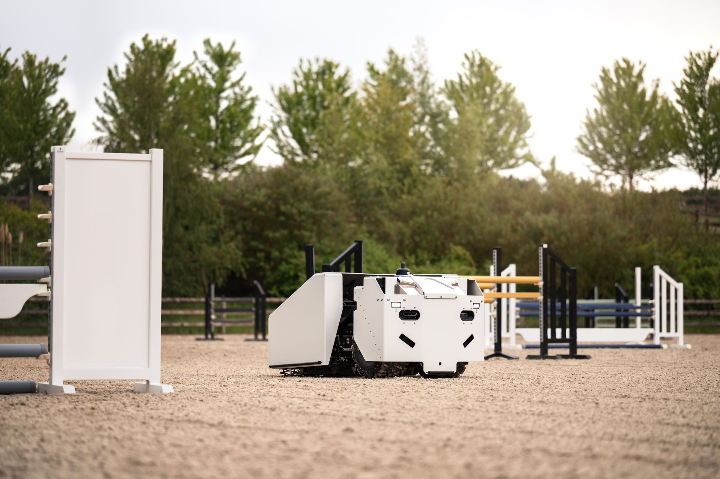
Fibered arenas, made of sand mixed with textile or geotextile fibers, provide better stability and greater comfort for the horse. However, they tend to harden quickly if not properly maintained. It is therefore essential to drag them deeply on a daily basis to turn and aerate the surface, allowing the fibers to mix with the sand and ensure optimal suppleness. Moisture is also a key factor: a fibered surface that is too dry loses its elasticity, while excess water makes it heavy and sticky.
In both cases, regular maintenance is essential. Adjusting the frequency of dragging and watering based on daily use and weather conditions not only ensures the safety and comfort of the horse–rider pair but also significantly extends the arena’s lifespan.
The HarrowBot: your ally in arena maintenance
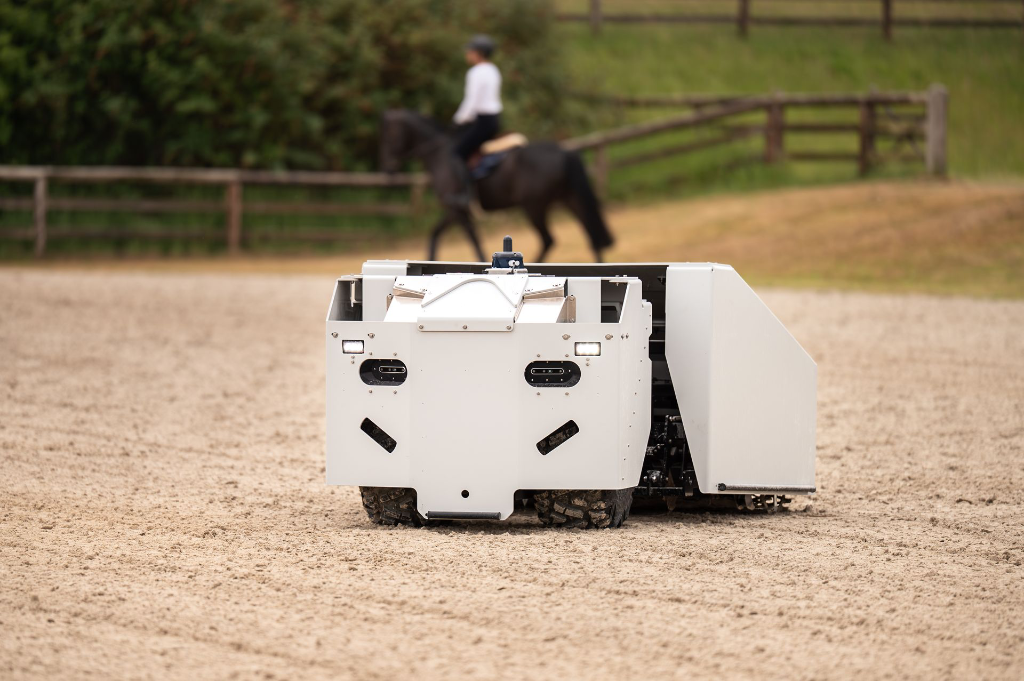
Le HarrowBot est un robot 100 % électrique conçu pour herser les pistes équestres en toute autonomieThe HarrowBot is a 100% electric robot designed to drag equestrian arenas completely autonomously. Weighing 400 kg, it achieves perfect balance: heavy enough to work the sand deeply without compacting it. Its carefully designed dimensions allow it to cover the surface efficiently while remaining highly maneuverable.
To ensure a consistent surface, the HarrowBot offers different working patterns: lengthwise, widthwise, in circles, clockwise, or counterclockwise. Each day, it can alternate both its working pattern and the starting point of its cycle.
This variation prevents the sand from always being moved in the same direction and ensures an even distribution of work.
The HarrowBot’s dragging process follows three fundamental steps:
- Claws and teeth: The claws, which penetrate deeply, are particularly suited for fibered arenas. They loosen and aerate the surface, preventing the formation of compacted zones. The teeth, which are more numerous and adjustable, are better suited for non-fibered arenas. They work more at the surface level, creating a compact yet structured footing.
- The leveling blade: Once the surface is loosened, the leveling blade evens out the arena and fills in irregularities. Its pressure is controlled by a system of springs and a hydraulic cylinder:
- Spring released: light contact, no pressure.
- Spring tensioned upward: the leveling blade (as well as the claws and teeth) lifts, making it easier for the robot to move.
- Spring tensioned downward: increased pressure to compact the surface if needed.
- The rollers: The final step involves the rollers, which refine the surface texture. Slatted or diamond rollers create an airy, soft, and light surface, while the Farmflex roller produces a compact, homogeneous, and even finish.
The claws and teeth, as well as the leveling blade, are equipped with a hydraulic cylinder that allows the depth and pressure to be applied to be set remotely.
Thanks to its precise and automatic settings, the HarrowBot adapts to all types of surfaces. Whether the sand is dry, damp, or fibered, it adjusts the depth of the teeth and claws as well as the pressure of the leveling blade to suit the arena conditions, which are themselves subject to weather variations.
Autonomous, it can also move from one arena to another, whether indoor or outdoor. As long as the path is clear, it moves on its own and continues its work without assistance.
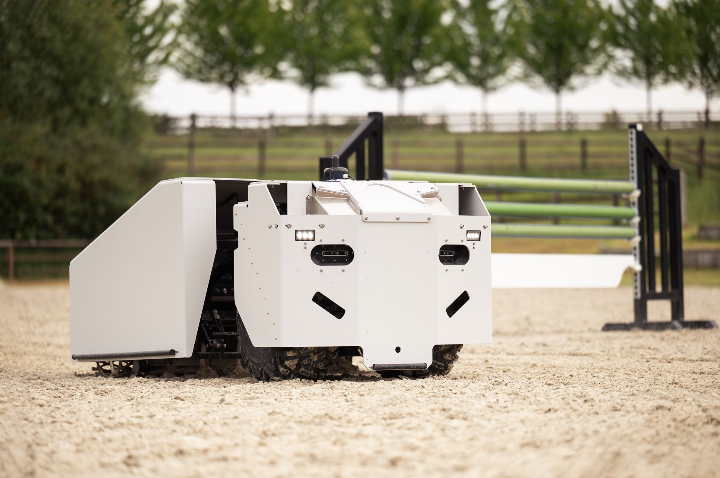
For show jumping riders, the HarrowBot also offers an innovative feature: the finishing pass. This special program targets the take-off and landing zones. During its cycle, the robot records the location of the obstacles and, at the end of its dragging, makes an additional pass around each obstacle to optimally treat these critical areas.
The result: an arena that is always consistent, high-performing, and ready to welcome riders and horses under the best conditions.
In conclusion, maintaining an equestrian arena requires time and consistency, but high-quality upkeep is essential to achieve an optimal surface. Whether fibered or non-fibered, the benefits of a well-prepared arena are immediate: rider safety, horse comfort and health, and the longevity of the facilities.
To support you and ease this task, the HarrowBot is here: a 100% electric, 100% autonomous robot capable of adapting to all surfaces and weather conditions. Investing in maintenance is investing in the quality of your work and the well-being of your horses. With the HarrowBot, every session becomes safer, more enjoyable, and more efficient.
A well-maintained arena is no longer a burden… it becomes a surface where every improvement can truly flourish.